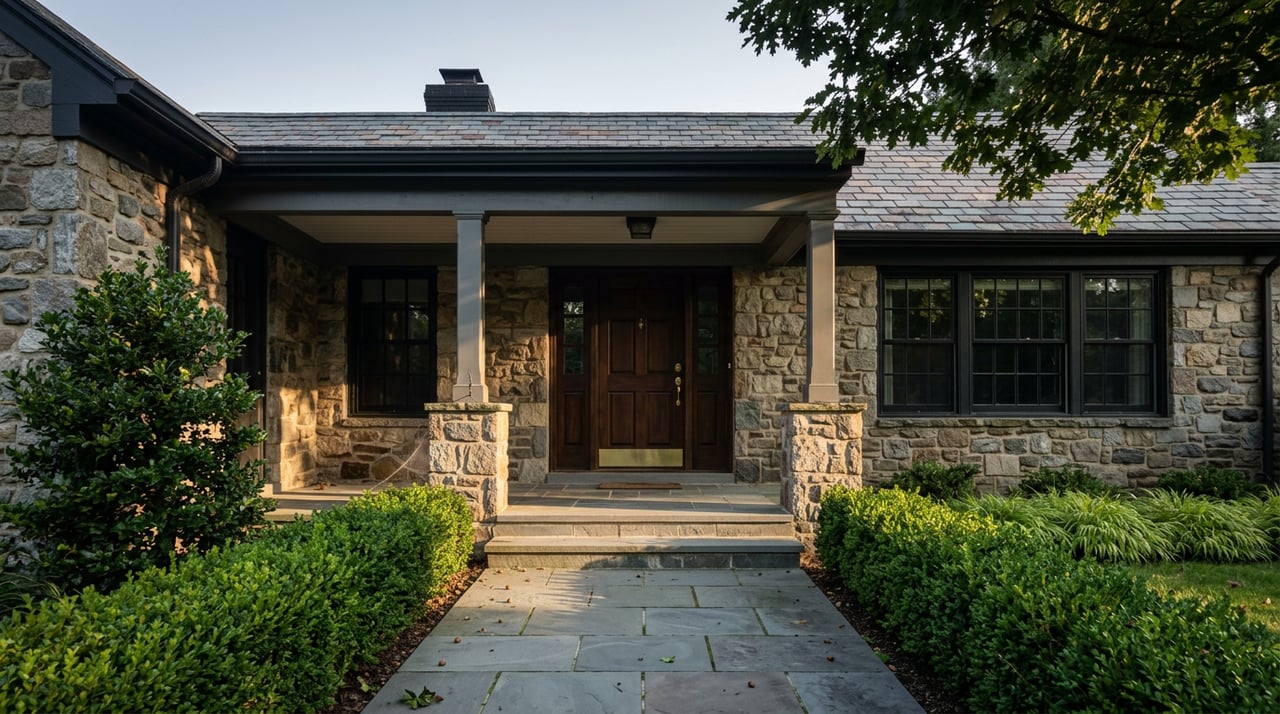
Stand at the corner of Lancaster Pike and County Line Road in Villanova and you are looking at a single, unbroken block of stone houses, mature trees, and identical zip code signage. Nothing on the ground tells you that the house on your left pays its school taxes to a different school board than the house on your right, gets its assessed value calculated by a different state formula, and would need a permit signed by a different township office if the owner wanted to add a garage. The county line runs straight through the neighborhood, and almost nothing about it is visible from the street.
That invisibility is the whole problem for anyone comparing Villanova listings on a portal. The zip code, 19085, treats both sides as one market. It is not one market. It is two townships wearing the same name, and the difference between them changes what a buyer's tax bill actually looks like before a single offer gets written.
One Zip Code, Two Governments
Villanova is unincorporated. It has no borough council, no mayor, no zoning board of its own. Instead it straddles two separate municipalities: Lower Merion Township, which sits in Montgomery County, and Radnor Township, which sits in Delaware County. The dividing line is County Line Road itself, along with the path of Lancaster Pike and Spring Mill Road running through the village center.
That village center is small by design. It holds the post office that serves the 19085 zip code, an office building, Wilmington Trust's Pennsylvania headquarters, a Royal Bank of Pennsylvania office, and a handful of smaller shops. There is no downtown strip to speak of, which is part of the appeal for people who want the Main Line address without the foot traffic of Wayne or Bryn Mawr. But the quiet village center also means there is no obvious landmark to tell a buyer which side of the line a listing sits on. You have to check.
The practical version of this split shows up first in schools. Homes east of County Line Road feed into Lower Merion School District. Homes on the other side feed into Radnor Township School District. Two families touring homes a few hundred feet apart, both listed as "Villanova," can end up zoned for entirely different districts, with different school boards, different budgets, and different boundaries that can shift with redistricting. A buyer who assumes "Villanova schools" is a single, stable answer is working from an assumption the map does not support.
Why the Tax Math Actually Flips at the County Line
School assignment is the part most buyer's guides mention. The tax mechanism underneath it is the part that rarely gets explained, and it is the real reason two comparably priced Villanova homes can carry noticeably different tax bills.
Pennsylvania counties do not reassess property every year. Instead, the state publishes an annual Common Level Ratio for each county, a factor that converts a home's old assessed value into a workable estimate of current market value. For the ratio period that took effect July 2025, the Suburban Realtors Alliance reported that Montgomery County's ratio was 30.76 percent of market value and Delaware County's was 57.33 percent. That is not a small gap. It means a home worth the same amount on the open market carries a dramatically different assessed value depending on which county it happens to sit in, because Montgomery County's assessment base has drifted much further from current prices than Delaware County's has.
Layer the actual millage rates on top of that and the picture sharpens further. The most recently published rates from Radnor Township set the township tax at 2.4852 mills, the Radnor Township School District at 15.7965 mills for the 2025-2026 school year, and Delaware County's rate at 3.873 mills, for a combined rate a bit above 22 mills. Lower Merion's total millage runs meaningfully higher, but it is applied against that much lower Montgomery County assessment base. The two systems are built differently on purpose, and a buyer comparing a listing on the Radnor side to one on the Lower Merion side is not comparing like to like just because both say "Villanova" in the listing description.
| Montgomery County side (Lower Merion Twp) | Delaware County side (Radnor Twp) | |
|---|---|---|
| County Common Level Ratio (as of July 2025) | 30.76% of market value | 57.33% of market value |
| School district | Lower Merion School District | Radnor Township School District |
| Approximate total millage structure | Higher millage, lower assessment base | Lower millage, higher assessment base |
| County | Montgomery | Delaware |
Neither structure is better or worse in the abstract. The point is that they are different systems, and the blended zip code median hides that entirely.
What This Means for the Number You're Actually Comparing
This is where the portal medians start to make more sense, and also where they stop being useful on their own. Recent snapshots put Villanova's median list price at $2.09 million in July 2026, with a per-square-foot figure around $416. Other portals, pulling from different windows and different mixes of Lower Merion side versus Radnor side inventory, have shown figures closer to $1.6 million to $2 million for the same zip code. That spread is not really about market softness or a data error. It is what happens when one number tries to describe two tax jurisdictions and two school districts at once.
There is a second layer to this that shows up on the ground rather than in a spreadsheet. Villanova, like most Main Line communities, is also bisected by Route 30 itself, and the pattern locals already know is that homes north of the pike tend to carry a premium over those south of it. Combine that with the county line running roughly perpendicular to it, and a single "Villanova" search can return four distinct micro-markets: north of Route 30 in Lower Merion, south of Route 30 in Lower Merion, north of Route 30 in Radnor, and south of Route 30 in Radnor, each with its own combination of school assignment, tax structure, and price tier.
For a buyer, the practical takeaway is not that Villanova is confusing and should be avoided. It is that the median on the listing page is a starting point, not an answer, and the real comparison happens once you know which side of County Line Road and which side of Route 30 a specific address falls on.
What to Check Before You Write an Offer
A few questions turn the invisible line into something you can actually work with:
Which township holds the parcel, Lower Merion or Radnor, and which county, Montgomery or Delaware, will issue the tax bill. This determines which Common Level Ratio applies to any future assessment appeal and which township office you would call for a permit.
Which school district the address is zoned for, confirmed directly rather than assumed from the listing's marketing copy, since "Villanova" alone does not settle it.
What the current combined millage actually totals for that specific parcel, since township, county, and school district rates are set independently and change on different calendars each year.
Whether the home's assessed value looks current relative to its county's Common Level Ratio, which matters most if you are budgeting for a possible tax appeal down the line.
None of this shows up cleanly in a portal search filter. It shows up in the deed, the tax record, and a phone call to the right township office. That is also where a Villanova-specific search becomes worth more than a Main Line-wide one, because the answer changes block by block rather than town by town.
Frequently Asked Questions
Is Villanova its own town with its own government? No. Villanova is unincorporated. It has no independent municipal government, and it is governed instead by whichever township, Lower Merion or Radnor, the specific property sits in.
How do I find out which school district a specific Villanova address is zoned for? The dividing line runs along County Line Road, with homes to the east zoned for Lower Merion School District and homes to the west zoned for Radnor Township School District. Because boundaries can be adjusted over time, the safest approach is confirming zoning for a specific address directly with the district rather than assuming based on the general rule.
Why do different real estate sites show such different median prices for Villanova? Because the zip code blends two counties, two school districts, and two tax systems into a single reported number. A snapshot taken from a Lower Merion-heavy pool of listings will read differently than one taken from a Radnor-heavy pool, even in the same month.
Does the county line affect anything besides schools and taxes? Yes. Zoning code, building permits, and any variance or renovation approval process run through whichever township holds the parcel, which means the same addition project can look different on paper depending on which side of the line the house sits on.
If you are comparing homes in Villanova and want to know which side of these lines a specific address falls on before you tour it, that is exactly the kind of groundwork Hernan Alvarado Jr does before a client ever writes an offer. Let's Connect.
This article is general information, not legal, tax or financial advice. Consult a qualified professional about your situation.